Signals for Health
Biomedical Sensing
Wearable sensors and signal processing for robust biomedical monitoring and diagnostics.
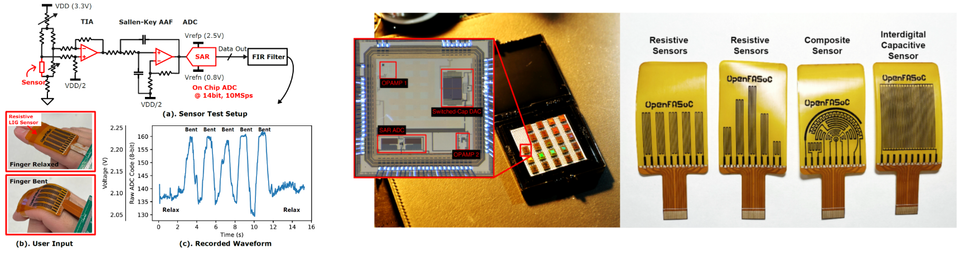
Sensor and Open-Source Silicon Chip for an Affordable and Robust Wearable Sensing System with Precise Temperature, Humidity, and Strain Sensing Capability [1][2]
We present the integration of the Laser-Induced-Graphene (LIG) sensors and the Analog Front-End (AFE) chip, all developed using open-source tools which facilitate an affordable prototyping for a multifunctional (temperature, humidity and strain) flexible wearable sensing system.
 Open full-resolution image (new tab)
[1] H. Wu, A. Li, G. Kielian and M. Saligane, "LIG-OSS: Integrated Laser-Induced-Graphene Sensor and Open-Source Silicon Chip for an Affordable and Robust Wearable Sensing System with Precise Temperature, Humidity, and Strain Sensing Capability," 2024 IEEE 19th International Conference on Nano/Micro Engineered and Molecular Systems (NEMS), Kyoto, Japan, 2024, pp. 1-5, doi: 10.1109/NEMS60219.2024.10639937.
[2] A. Li et al., "Rapid Prototyping of Laser-Induced Graphene Sensors With Open-Source Silicon: Paving the Way for Low-Cost and Robust Flexible Wearable Sensing," in IEEE Solid-State Circuits Magazine, vol. 16, no. 2, pp. 49-57, Spring 2024, doi: 10.1109/MSSC.2024.3380586.
Human-Body Communication (HBC) [3]
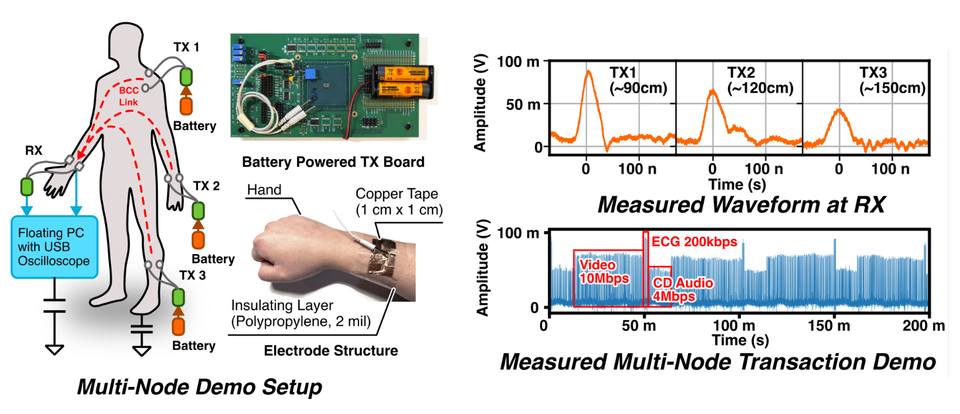
HBC systems use the human body as a conductive medium to transmit data between wearable or implantable devices, reducing radiated energy and improving privacy. A typical HBC link includes body-coupled transmitters and receivers that modulate signals through electrodes and measure the resulting potential differences across the body.
 Open full-resolution image (new tab)
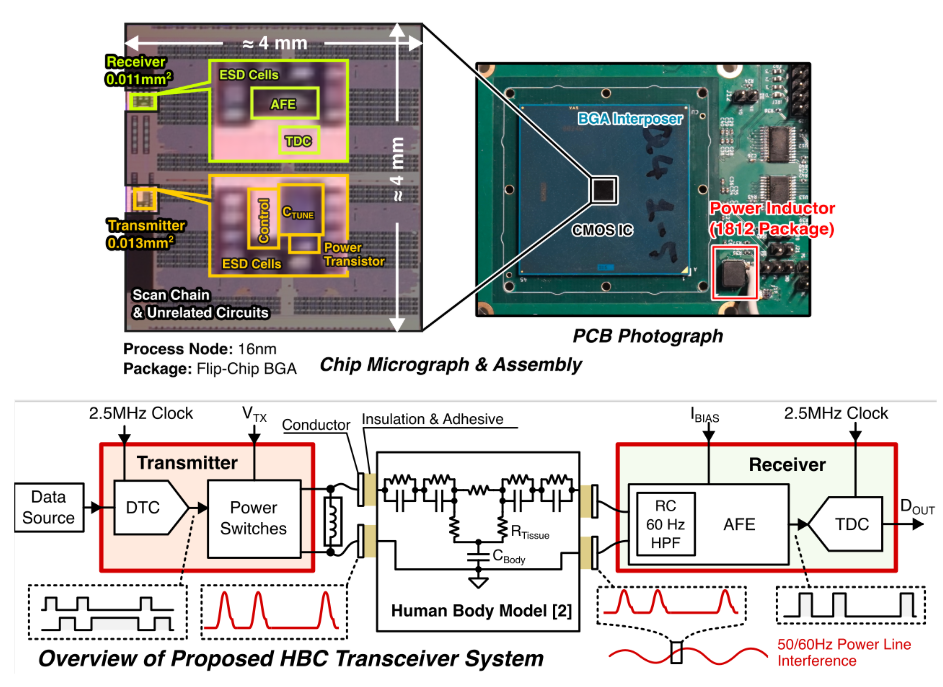
We developed an inductive-resonance transceiver using pulse-position modulation and taped it out in 16 nm technology. The associated 2026 CICC paper reports 2.2 pJ/b operation for 15 Mb/s multi-source body-area communication.
 Open full-resolution image (new tab)
The 16 nm HBC transceiver reported at CICC 2026: chip micrograph, assembly, and system overview.
[3] A. Li et al., "A 16nm 2.2pJ/b High Efficiency Pulse-Position Modulated Resonance Transceiver for 15Mbps Multi-Source High-Speed Body-Area Sensor Network," in IEEE Custom Integrated Circuits Conference (CICC) 2026.
SIMFONY: Integrated Health Monitoring [4]
Our SIMFONY health-monitoring node integrates HBC, single-inductor multiple-output (SIMO) power delivery, photoplethysmography (PPG), and on-node inference, with 1.2 µW standby power. We bring sensing, communication, power delivery, and inference together in a multiplexed single-inductor, multi-function node.
The paper was presented at ESSERC 2026 in Palma de Mallorca, Spain. Read our conference announcement or view the conference program.
[4] A. Li, J. Luo, R. Qi, H. Wu, D. Sylvester and M. Saligane, "SIMFONY: Multiplexed Single-Inductor Multi-Function 1.2 µW Standby Health Monitoring Node with HBC, SIMO, PPG, and Inference," in 52nd IEEE European Solid-State Electronics Research Conference (ESSERC), Palma de Mallorca, Spain, 2026.